In this Charging Stack podcast episode, we talk with Marcus Adolfsson, Co-Founder & CEO of Standab, a Swedish infra-tech company building operator-agnostic parking and charging infrastructure for micromobility fleets.
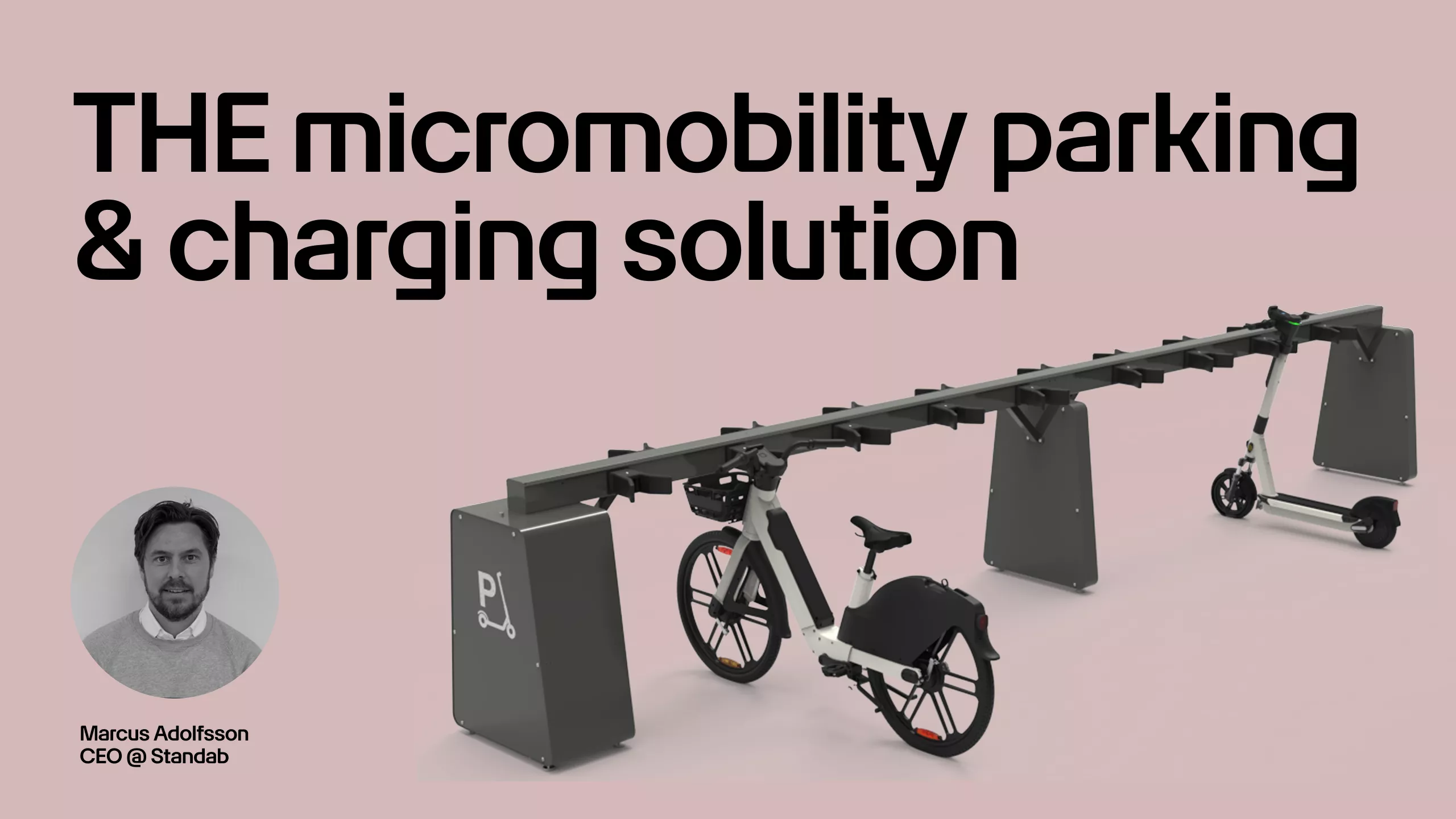
Standab’s Marma system turns messy scooter and e-bike parking into organised, powered hubs that any operator can use. A MagSafe-style magnetic connector, universal adapters, and self-weighted racks that plug into a simple 230 V outlet help cut battery swaps, reduce street clutter, and boost fleet uptime. Backed by €3.6M+ in funding (including EIT Urban Mobility), Standab is now rolling out its network across Europe.
Marcus explains how Standab spun out from an urban furniture business, what it took to design a truly universal charging interface, and why “charging as a service” can work for both cities and operators. We also talk about fire safety, private light-EV charging, and what a mature micromobility infrastructure layer might look like in 2030.
Prefer reading instead of listening? Check out our full Standab profile for a breakdown of the business model, use cases, and strategy.
You work at a shared micromobility operator and want to cut battery swaps and van miles
You manage mobility or street design for a city and need cleaner, safer scooter and e-bike parking
You build hardware or software for light EVs and want to understand “universal” charging in practice
You’re exploring business models around charging as a service, infra-tech, or urban energy
In this episode, you’ll learn:
⚡ How Standab went from bike racks to a universal micromobility charging hub ⚡ What makes Marma compatible with 85%+ of existing scooters and e-bikes ⚡ How MagSafe-style connectors and simple 230 V plugs improve user experience and deployment speed ⚡ Why charging as a service changes the capex equation for cities and operators ⚡ Where Standab wants to be by 2030 and how it thinks about private light-EV charging
Topics covered include
The origin story: how 25,000 scooters in Stockholm pushed Standab to tackle parking and charging
Why EV charging has an EU-level plan while light electric vehicles have almost none
How Standab’s first parking projects in Hamburg led to a deeper focus on charging
Designing Marma around user experience: slide-in parking, magnetic connectors, and no kickstands
What it took to make the hardware “universal” across different frames, IoT units, and battery voltages
Working with suppliers like Okai and Ninebot to retrofit existing fleets and prepare new models
Pilot results from Nordic cities: fewer swaps, higher availability, and more trips per equipped vehicle
How self-weighted racks and no groundwork simplify permits, relocation, and street operations
The charging as a service model: Standab carries capex, cities provide space, operators pay per use
Why fire safety and lithium-ion risk make controlled charging infrastructure increasingly important
How Standab is thinking about battery hubs, private bike charging, and campus or residential use cases
The role of public transport authorities and city governments in planning a connected mobility ecosystem
Why Marcus wants better alignment between cities and PTAs instead of isolated tenders and rules
Standab’s expansion goals: 15+ European cities by 2026 and roughly 200 markets in Europe by 2030
Subscribe to Charging Stack for more podcast episodes, deep dives, and case studies with the people keeping the future of mobility running. ⚡
Share your love
Filip Bubalo
Researcher & writer for Charging Stack. Marketing manager at PROTOTYP where I help mobility companies tell better stories. Writing about the shift to electric vehicles, micromobility, and how cities are changing — with a mix of data, storytelling, and curiosity. My goal? Cut through the hype, make things clearer, and spotlight what actually works.