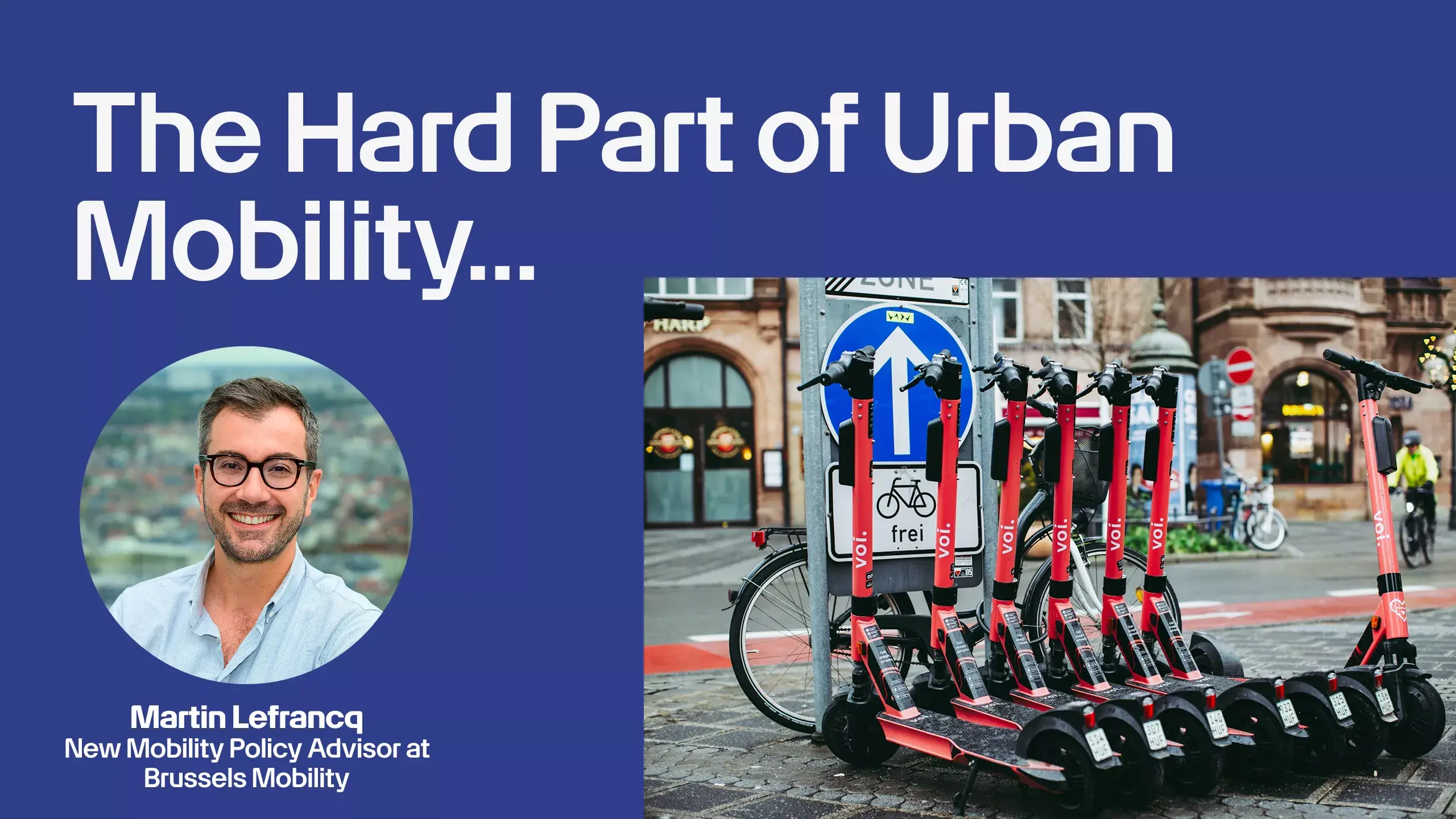
In this Charging Stack interview, we sit down with Martin Lefrancq, New Mobility Policy Advisor at Brussels Mobility, to unpack what it really takes to make urban mobility work after the hype phase.
We talk tenders, enforcement, data governance, mobility hubs, behavior change, and why “just add more tech” rarely fixes public space.
This episode is for you if:
You work in urban mobility, transport planning, or parking policy
You deal with shared mobility regulation (scooters, bikes, car-sharing)
You’re building MaaS, running pilots, or managing operator data requirements
You care about public space design, enforcement, and the real friction points
You want a grounded take on autonomy, electrification, and mode shift in Europeact
In this episode, you’ll learn:
⚡ How Brussels moved from free-floating disorder to a coordinated shared-mobility ecosystem ⚡ What cities often misunderstand about regulating scooters, bikes, and new vehicle types ⚡ Why parking, placement, and street space matter more than most product debates ⚡ How mobility hubs should work, and why scaling them is harder than it sounds ⚡ Which operator data cities actually need, and what’s just noise ⚡ What MobilityChangers proved about real behavior change (and why it worked) ⚡ What Martin observed firsthand in China’s AV deployments, and what Europe should take from it ⚡ The tension between electrification, mode shift, and reducing car dependency ⚡ What success looks like for Brussels by 2030 to 2035, and the key metric behind it
Topics covered include
Martin’s path from industrial engineering and public space lighting into mobility policy
Why Brussels is uniquely complex to govern (region plus 19 municipalities)
The micromobility timeline in Brussels: early licensing, oversupply, then tenders and limits
Drop zones and parking enforcement: what improved, what still breaks daily
Public-private friction: why cities and operators often talk past each other
“Bikelash” and political pushback: how it shows up and what to do with it
Mobility hubs: strategy vs on-street reality (permits, maintenance, rollout speed)
MobilityChangers: coaching, mobility budgets, and why some families sold a car after
China field notes: scale of robotaxis, AV logistics, and the policy mindset behind it
Why Martin sees e-bikes as the biggest near-term shift for cities
Brussels’ mode share target and why it is the clearest scoreboard
Subscribe to Charging Stack for more podcast episodes, deep dives, and case studies with the people keeping the future of mobility running. ⚡
Share your love
Filip Bubalo
Researcher & writer for Charging Stack. Marketing manager at PROTOTYP where I help mobility companies tell better stories. Writing about the shift to electric vehicles, micromobility, and how cities are changing — with a mix of data, storytelling, and curiosity. My goal? Cut through the hype, make things clearer, and spotlight what actually works.