
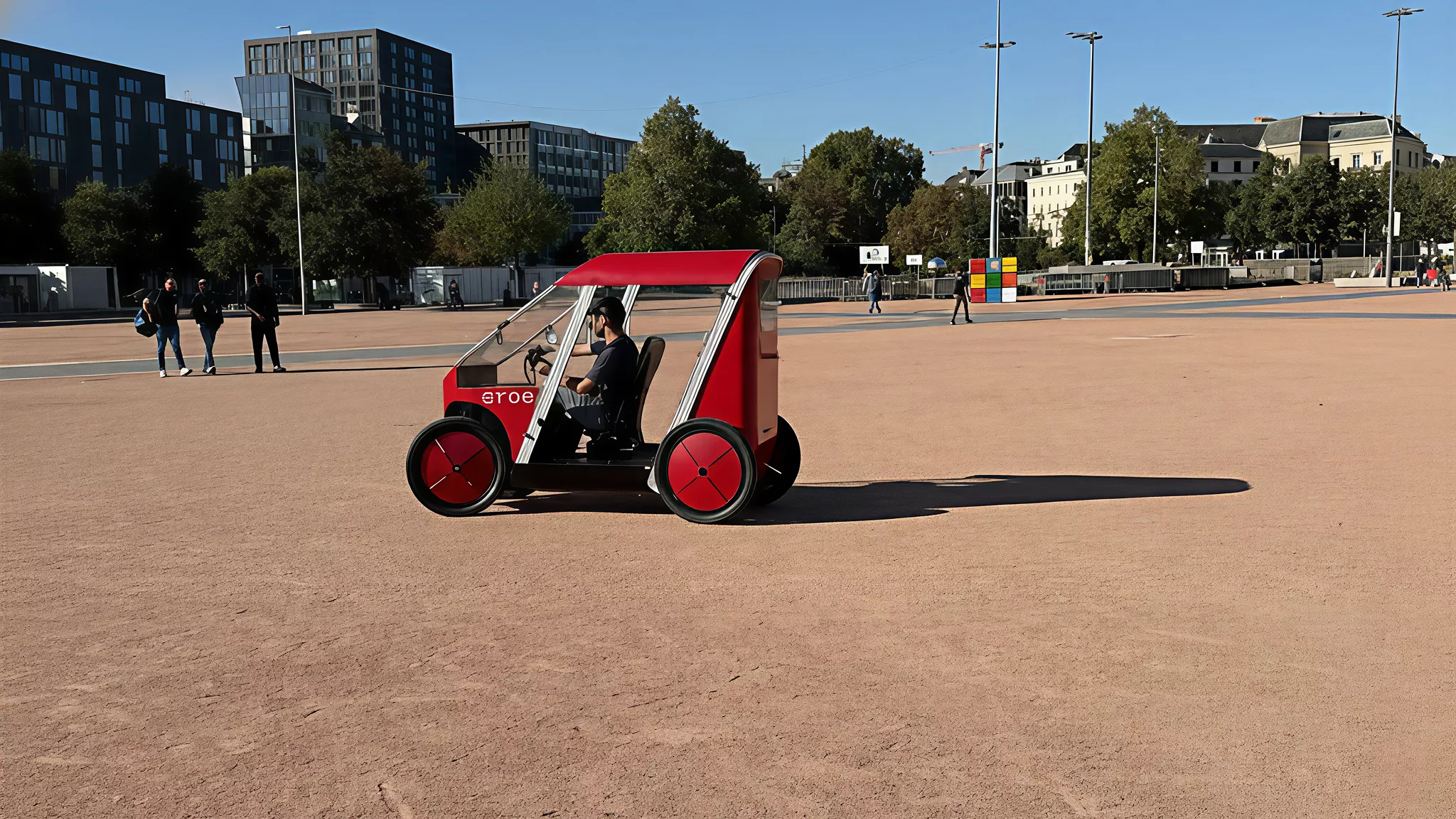

E-roe Wants to Fix The 0–15km Trip With a Circular Light EV
Share your love
Most mobility talk still swings between two extremes – bikes for the brave, and cars for everything else.
But the real battle is in the boring middle, the daily 0–15 km trip. Too far to walk, too awkward to haul things on a bike, and wildly inefficient to do in a full-size car. That’s where e-roe is aiming.
Founded in 2024, the French industrial startup is building a light electric vehicle called the e-roe One and pairing it with a bigger idea – if you want “clean” mobility to scale, you must redesign the way it’s made, repaired, and kept alive for years.
The 0–15 km gap (and why bikes and cars both miss it)
Most mobility problems start with small errands that stack up.
School drop-off. Groceries. A short work run. Picking up a parcel. Moving tools to a job. Ten minutes here, fifteen there. The kind of trip you do without thinking. Until you have to do it every day.
This 0–15 km band is where cities get a bit messy. More cars circling for parking, more vans blocking curbs, and more traffic from trips that are too short to justify a full-size vehicle. It also adds up fast in cost and energy.
Bikes and cargo bikes can cover a lot of it. But real life narrows the audience. Rain, cold, heat, fast traffic, heavy loads, hills. Even with e-assist, there’s a point where a “quick ride” turns into friction. For organizations, it’s also operations – theft risk, wear, repairs, rider confidence, and training.
Cars solve comfort and protection. They also bring weight, space demand, and repair bills that rarely match the task. Even electric cars still move a lot of mass for a short trip.
So the choice we’re left with boils down to two options – exposed but efficient, or protected but oversized.
The middle needs a different tool. Small enough to park easily. Protected enough for year-round use. Strong enough for real cargo. Simple enough to keep running. That’s the slot e-roe is going after.
e-roe’s bet
E-roe focuses on the 0–15 km trip. That distance covers a huge share of everyday movement, and it offers the best leverage for cutting emissions with minimal energy and material.
The company ties the vehicle to the industrial system behind it. The goal is a platform that fits daily use and keeps working over time, with less waste built into the lifecycle.
Circularity shows up in the design choices. The vehicle is built to come apart. Repairs are meant to be quick. Components are treated like parts with their own timelines. When something wears out, it gets replaced without writing off the whole vehicle. That keeps more of the platform in service for longer, which matters as much as the drivetrain.
The business model supports that logic. A rental-first approach keeps the fleet within one loop. Usage can be tracked, maintenance can be planned, and vehicles can be recovered and refreshed instead of lost to fragmented ownership.
E-roe is building for repeat use, long life, and a smaller footprint across the full cycle.
The e-roe One, and what it can do
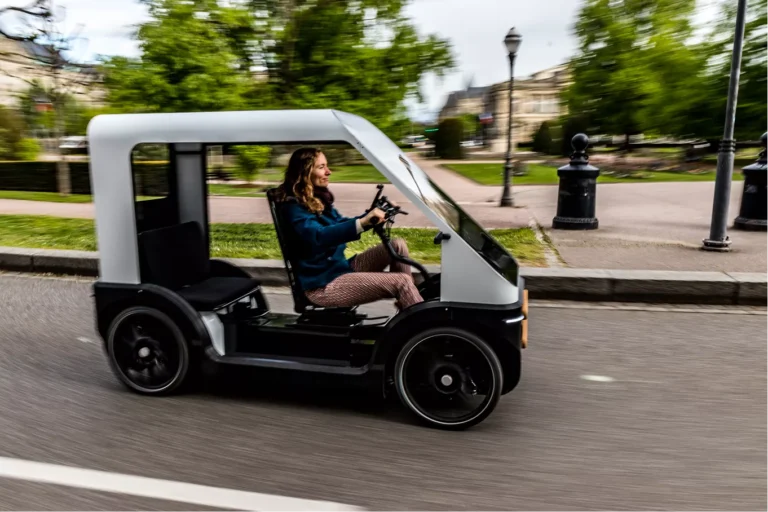
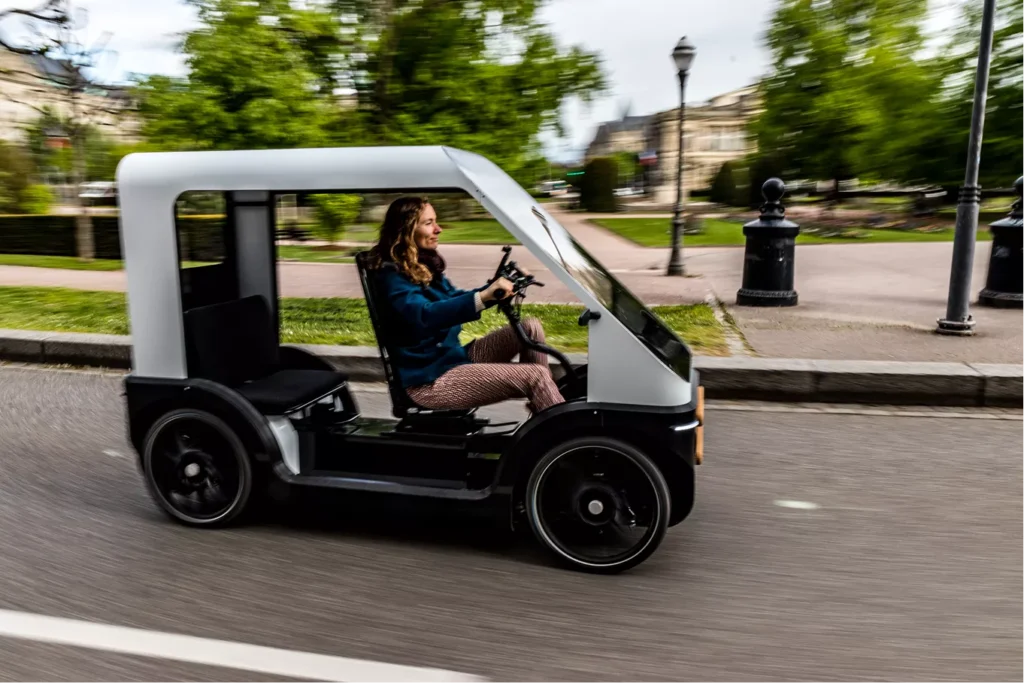
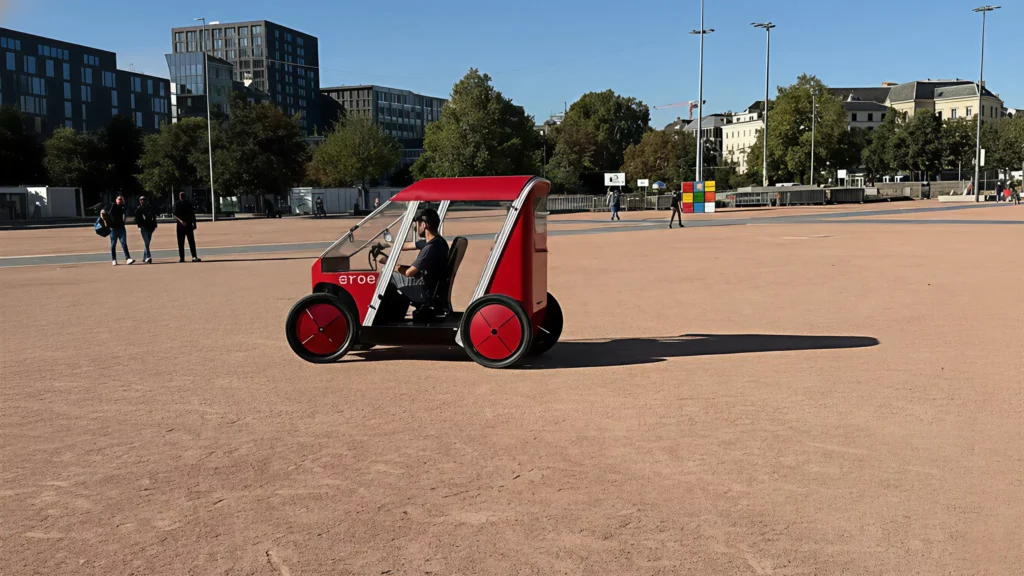
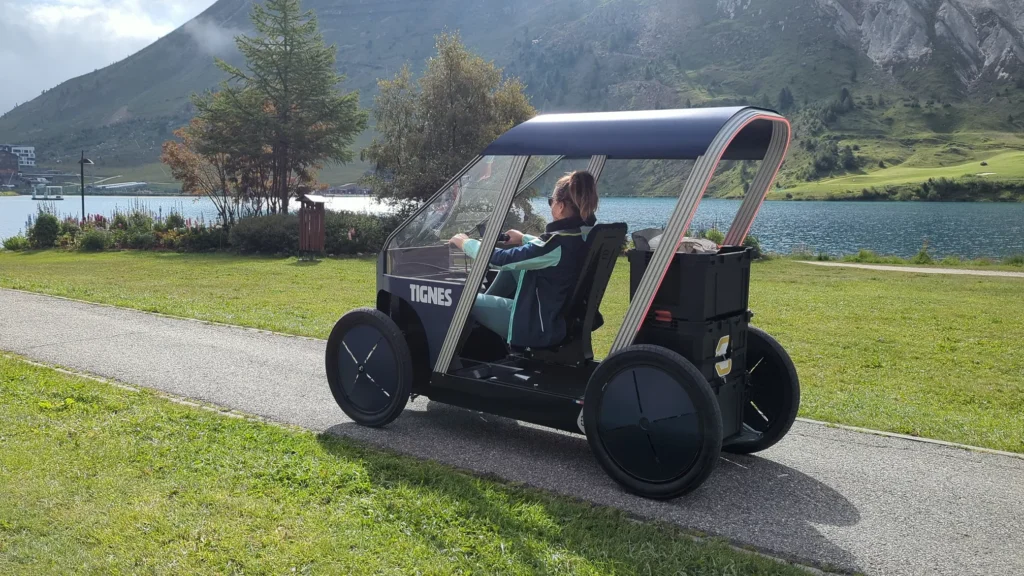
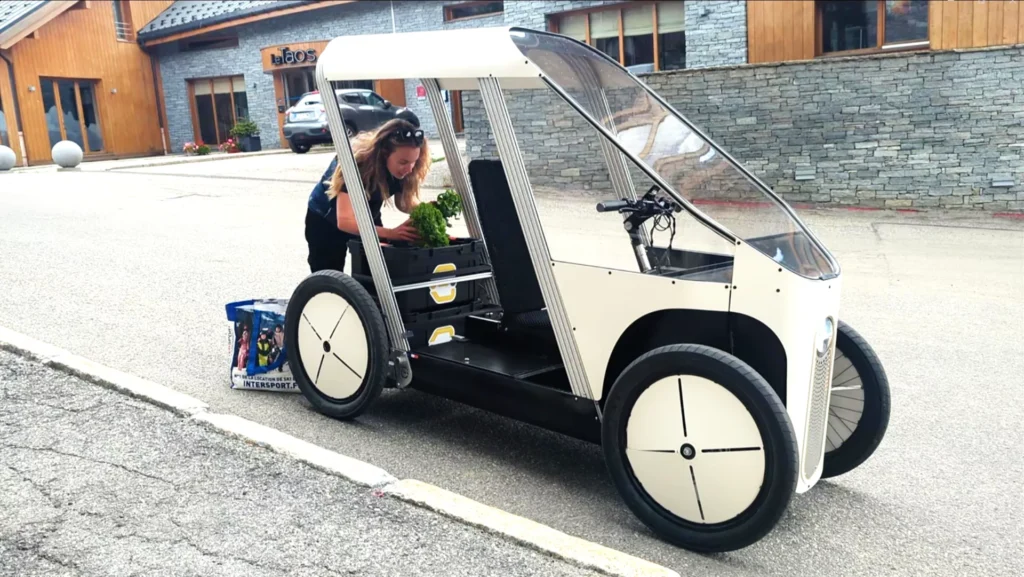
The e-roe One is built for short, repeat trips in the 0–15 km band. It uses a compact four-wheel format and an enclosed cabin, with a layout aimed at utility, stability, and everyday comfort.
The first version is designed to fit the EPAC category. That keeps operation simple and familiar for the markets where that classification applies, with assist up to 25 km/h and the practical benefits that come with it.
The drivetrain concept is also part of the efficiency story. Pedaling feeds a generator that charges the battery and supplies power to the rear wheels. Braking recovery is part of the system. The goal is a setup that stays consistent under heavy daily use and reduces maintenance pain for fleets.
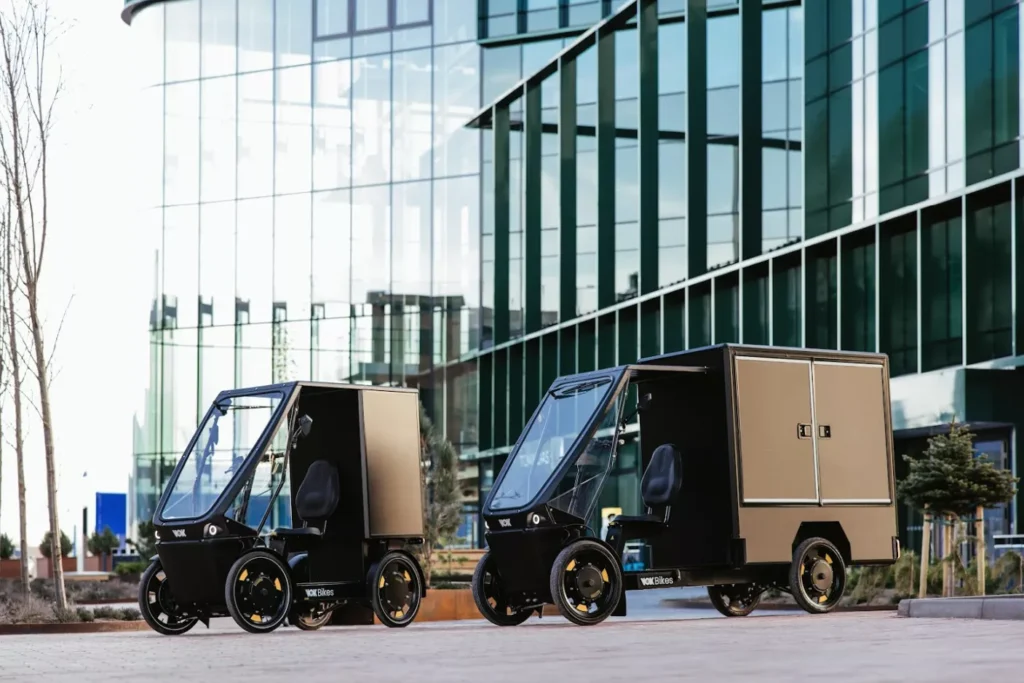
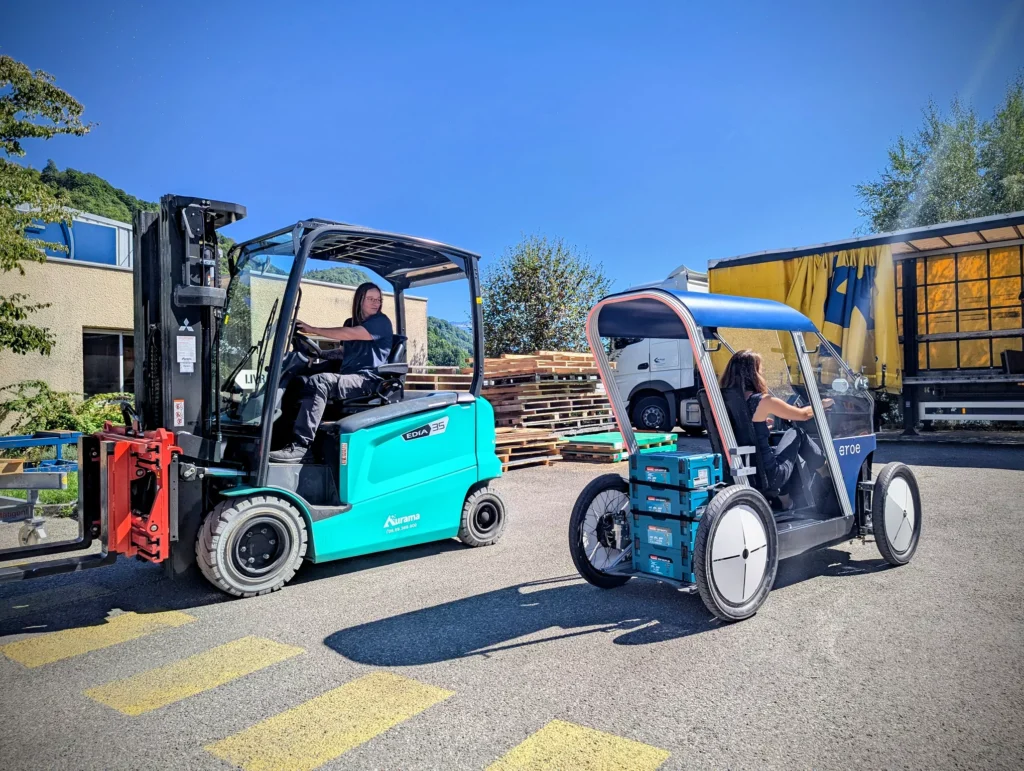
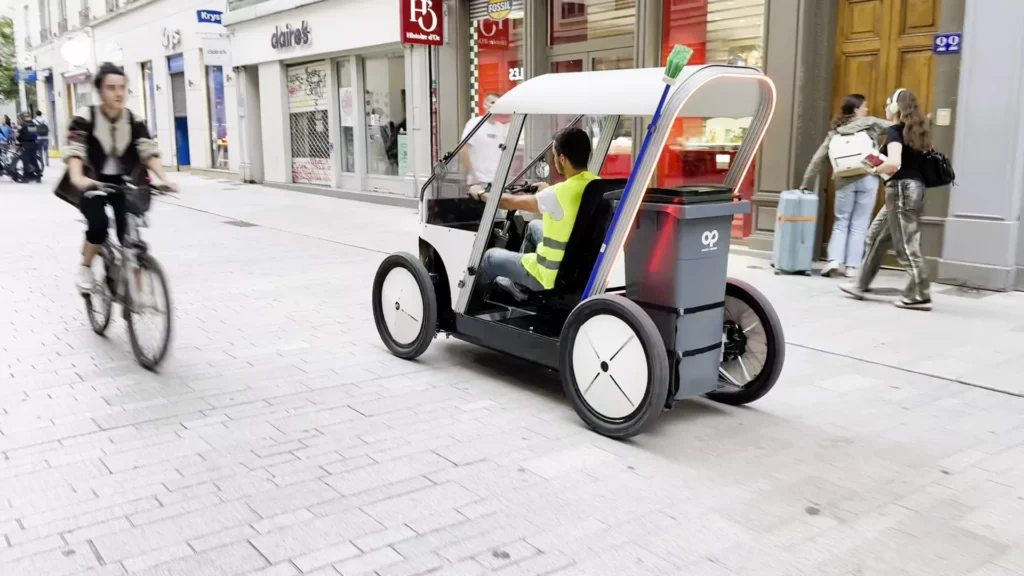
The platform supports different roles. Passenger layouts and cargo setups share the same base, so operators can configure it for local shuttles, municipal work, last-mile jobs, and site logistics without treating each use case as a separate vehicle program. Footprint-wise, it’s designed to stay close to the space a cargo bike takes, while offering far more enclosed volume.
The specs look great
- Payload: up to 250 kg
- Cargo volume: 600 or 1,000 liters, depending on configuration
- Range: up to 120 km, with real-world use anchored around daily short routes
- Speed: 25 km/h for the EPAC-focused version, with 45 km/h variants discussed as part of the broader lineup
- Battery scale: a 12 kg battery is part of the cost and efficiency target
Put together, it reads like a fleet tool. Compact, high-utility, and designed around daily operating reality rather than occasional peak performance.
Proof e-roe works
Specs create interest. Field use creates confidence. E-roe has leaned on pilots and stress tests to show the One can handle real conditions, real users, and real terrain.
Tignes pilot
Tignes works as a test bed because it concentrates the real constraints that shape short-trip mobility. Routes are short and repetitive. Space is limited. Weather shifts quickly. Loads change throughout the day. The users are mixed too, from municipal teams to local professionals to visitors.
What matters is the setting, not the marketing. A platform built for daily work has to hold up when people use it as a tool, without coaching and without special treatment.
E-roe positioned the Tignes deployment as a field test to gather operational learnings and user input in demanding conditions. That kind of pilot is a practical milestone on its own. It shows the One has moved beyond controlled demos and into environments where day-to-day usability and reliability get tested.
Col de l’Iseran test
In July–August 2025, e-roe took the One up to the Col de l’Iseran, the highest paved mountain pass in Europe at 2,764 meters. The route covered 56 km round trip with 1,340 meters of elevation gain. E-roe completed it on a single 1,440 Wh battery, with energy recovery on the descent playing a key role.
This is a strong proof point because it tests fundamentals that matter everywhere. Power delivery under load. Efficiency when the route gets hard. Regeneration that returns usable energy, not just a dashboard animation.
Once a light platform holds up in that environment, the everyday city route starts to look simpler. It becomes easier to trust the efficiency claims, and easier to treat the vehicle as a tool that can take a beating and keep going.
The propulsion twist: CIXI PERS
The e-roe One uses a drivetrain most people have never tried.
Pedals do not drive a chain, a belt, or a gearbox. They feed a generator. The vehicle then turns that input into propulsion through software and electric drive, so pedal effort and wheel drive are linked electrically rather than mechanically.
That changes the platform in a few important ways.
It frees up the layout. With no chain line to route and no gear system to package, the pedals can sit where the ergonomics make sense, and the motor(s) can sit where weight balance and service access make sense.
It also makes effort consistent. PERS is designed around selectable rider effort levels, with the system adapting resistance and assistance through control logic rather than fixed gearing.
Then there’s recovery. Regenerative braking and downhill recovery are part of the concept, and e-roe has leaned on that in its own validation story. In the Col de l’Iseran test, the company completed the route on a single battery and highlighted the role of recovery on the descent.
In practice, this is why PERS matters for e-roe. It supports a utility-first vehicle that still feels intuitive to use, even when terrain and loads stop being “flat-city easy.”
Circular design and an access-first rollout
E-roe treats lifecycle as part of the product. The One is designed for repeat use, fast service, and recovery, with the goal of keeping the platform valuable long after the first deployment.
Dismantle, repair, remanufacture
The core design rule is disassembly. Parts are meant to come apart cleanly so fixes stay quick and cheap, instead of turning into a time sink that sidelines the whole vehicle.
The important distinction here is remanufacturing. The idea is to recover vehicles at end of life, repurchase the chassis, and rebuild the next unit by swapping worn or damaged modules while keeping what still has value. Recycling remains the last step, used only when a part truly can’t stay in the loop.
That only pays off on real fleet timelines. E-roe frames those lifecycles at roughly five to six years in shared mobility and fleets, then recovery kicks in and the economics improve again once the first chassis comes back.
Keeping vehicles inside the loop
Circularity needs a reliable return path. When vehicles get scattered across owners and disappear, recovery becomes guesswork. A model built around managed fleets makes the loop much easier to run, because the operator knows where assets are, when they’re due for service, and how to bring them back in.
That’s why the rollout leans B2B first, with shared mobility positioned as a way to get more people testing the vehicle early. In the near term, the plan also includes holding back a small batch specifically so customers can rent and trial before committing.
What to watch next
E-roe has a clear thesis and early proof points. The next phase is execution. The signals below will show whether the platform can move from prototypes and early field tests into repeat deployments, with an industrial loop that holds up under scale.
Scaling signals
Watch for evidence that the system is becoming repeatable across places and partners.
- Manufacturing readiness – A defined production plan, stable lead times, and consistent build quality. The step from prototypes to repeat builds is where timelines and costs get real.
- European supply chain depth – Long-term agreements with key suppliers, plus at least one industrial partner capable of scaling output without redesigning the product around factory constraints.
- Service and remanufacturing infrastructure – Clear processes for recovery, inspection, refurbishment, and redeployment. Circular design can become a moat when the loop runs with speed and discipline.
- Fleet deals that reflect daily work – Deployments with municipalities, resorts, and operators running short routes every day. The strongest signal is steady usage outside demos and launch moments.
- Platform expansion without platform sprawl – New modules and configurations that share the same core components, instead of a growing list of bespoke variants.
Risks
E-roe’s ambition sits in a zone where execution risk stacks quickly. These are the big ones.
- Regulation and category fit – Light vehicle rules vary by country and city. Access, licensing, speed limits, and operating permissions can change deployment economics.
- Production ramp and quality control – Small inconsistencies become large costs at scale. Reliability, parts availability, and repair workflows will shape customer trust early.
- Capital intensity – Building vehicles, supporting fleets, and standing up recovery workflows requires funding that matches the pace of growth. Cash flow timing matters as much as market demand.
If those risks stay controlled, the thesis becomes easier to believe in a wider set of markets.
Where this goes next
E-roe is building for a part of mobility that rarely gets purpose-built hardware. Short trips make up the bulk of daily movement, yet the tools we use for them still sit at the extremes.
The e-roe One is a serious attempt at a middle layer that works in practice. It stays light, carries real load, and has already been pushed beyond the easy use case. That combination gives the concept credibility.
The bigger question sits behind the vehicle. E-roe treats manufacturing, repair, and recovery as part of the product. If that loop holds up under real scale, it becomes a model other mobility companies will have to learn from.
The next phase is simple to describe and hard to execute. Build consistently, keep fleets running, and prove the lifecycle logic in the field. That is where the story gets decided.